


Our employees take use of a well-designed child care facility. Several instructors and staff members are dedicated to providing the students with a fundamental education while also fostering their mental development. The expenditures connected with the child care facility are completely covered by our contributions.
The daycare centers are specifically created for the young children of garment workers who work in the factories. Each center is staffed with three caregivers who are certified and well-trained. The caregivers are required to complete mandated training in areas such as child development, health and nutrition, and learning by doing. According to the proposal, the monthly childcare service charge will be around US$50 per month per child, with the fee being completely subsidized by us. The centers are available six days a week to fit the working schedules and hours of the workers that utilize them.
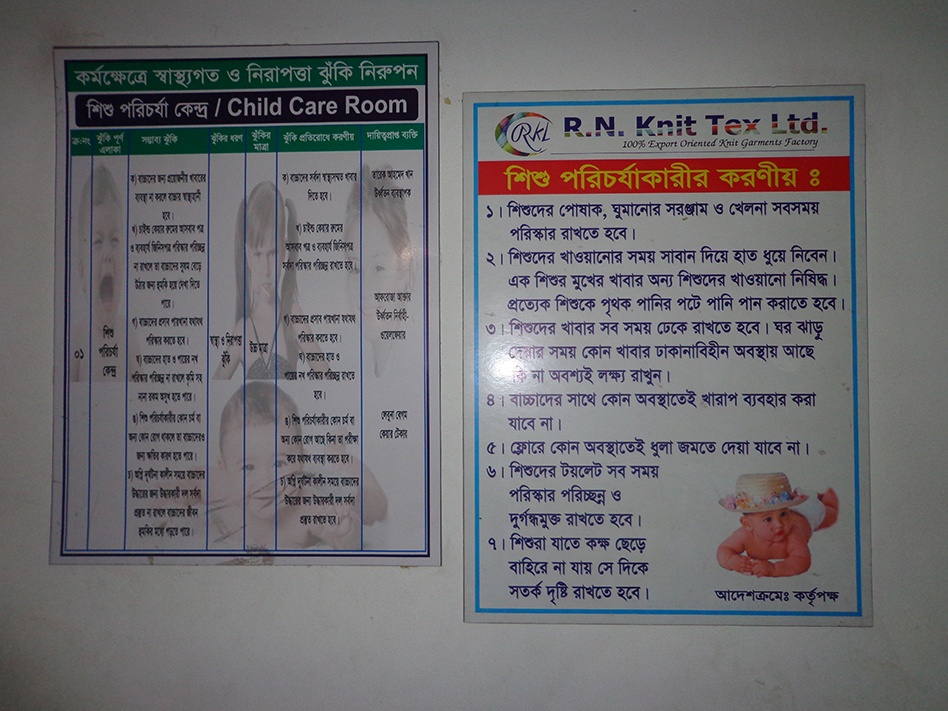
We think that if we want to develop a strong human resource base, we should begin by making investments from a young age. Childcare centers are excellent venues to begin the process of human development. These institutions give an excellent chance for children from less affluent households, notably those of garment factory employees, to receive high-quality care and education on par with that provided to children from more affluent families.
A study conducted by the International Finance Corporation on childcare alternatives found that a lack of childcare options can result in increased employee turnover and absenteeism, worse employee satisfaction and productivity, as well as a difficult time hiring top talent. It is important for women, who undertake 75 percent of all unpaid care labor in the world, to be aware of the unavailability or unaffordability of childcare since it might influence their job decisions. A more succinct expression would be that giving access to childcare allows more women and men to participate in paid occupations.
Absences, resignations, requests for maternity leave extensions and other absences have a significant impact on our production chain. When we have to hire new employees, it takes at least one month to get them up to speed on the company’s procedures. Therefore, in order to reduce the turnover rate, we have made significant investments in our childcare centers, so that our staff have one less thing to worry about while at work.
The fact that many young women seek employment in the Bangladeshi ready-made garment sector, but that chances are often limited owing to a shortage of childcare facilities, became apparent to us very early on. When women and girls become economically dependent in a society where sexual health and rights are not sufficiently taught in schools and where child marriage, gender-based violence, and eve-teasing are rampant, they are compounding the already precarious position they find themselves in. At the moment, only a little amount of attention is dedicated to the provision of sufficient child care for working parents. The majority of factory owners provide extremely minimal services, if any at all, and many do not see the financial benefits of providing childcare for their employees. Consequently, our management decided to set our organization apart from the competition by establishing our child care facility. Women constitute the majority of employees in Bangladesh’s export processing zones, and as a result, any investment in this group will have far-reaching consequences, both from an economic and social standpoint. It has been demonstrated that creating women-friendly workplaces has a demonstrable and favorable impact on our company’s bottom line. We make certain that our child care center provides enough supervision for their children while they are at work in our factories for this reason.
The childcare center has proven to be a successful complement to our overall strategy, resulting in substantial benefits for our employees. The company has achieved its corporate objectives while also reducing absence and turnover while increasing productivity and increasing worker loyalty. At the same time, the company has achieved legal compliance and risk mitigation while improving worker satisfaction and employee-management communication.
During the next few years, we hope to supply fortified diets to women workers and micronutrient supplements to a significant number of their children under the age of five. Malnutrition is one of the most serious public health problems facing the globe today, and Bangladesh has among of the highest rates in the world. In Bangladesh, there is an urgent need to address the intergenerational loop that inhibits mothers and their children from living a healthy lifestyle. United Costume Limited is driven by a strong desire to provide practical answers to the challenges faced by working moms in the knitwear manufacturing business.